High Income Equities
Portfolio Holdings:
How to use this information:
Sortable Headers: Click a header to sort the table by that metric.
Tgt. Wgt. (LT-Rating): This value is the target holding weight within the portfolio, and collectively they add up to 100%. This value also serves as a long-term rating. Specifically, this is a compelling enough position to hold in that particular weight for the long-term (or until something fundamental changes about the holding).
Yld: This is the distribution yield of the position. Specifically, how much did the position pay out to investors over the last 12 months as compared to the current share price.
1D%: This is the price change for the most recent trading day.
52W: This is the current price as a percent of the 52 week high and low price range (the high and low price are listed at the right and left side of the progress bar).
Rating (Near-Term): Short-term market noise can drive share prices above or below their long-term value. Shares generally don’t make it into the portfolio on near-term ratings alone (they have to be long-term compelling), however near-term ratings can create compelling opportunities to add shares and/or rebalance portfolio weights.
Buy Under: This is the price at which it can make sense to purchase shares from a valuation standpoint. The percent above or below the current share price drives the near-term ratings.
Risk Management
HIE Asset Allocation
This chart gives you a high-level look at the allocation categories for this strategy.
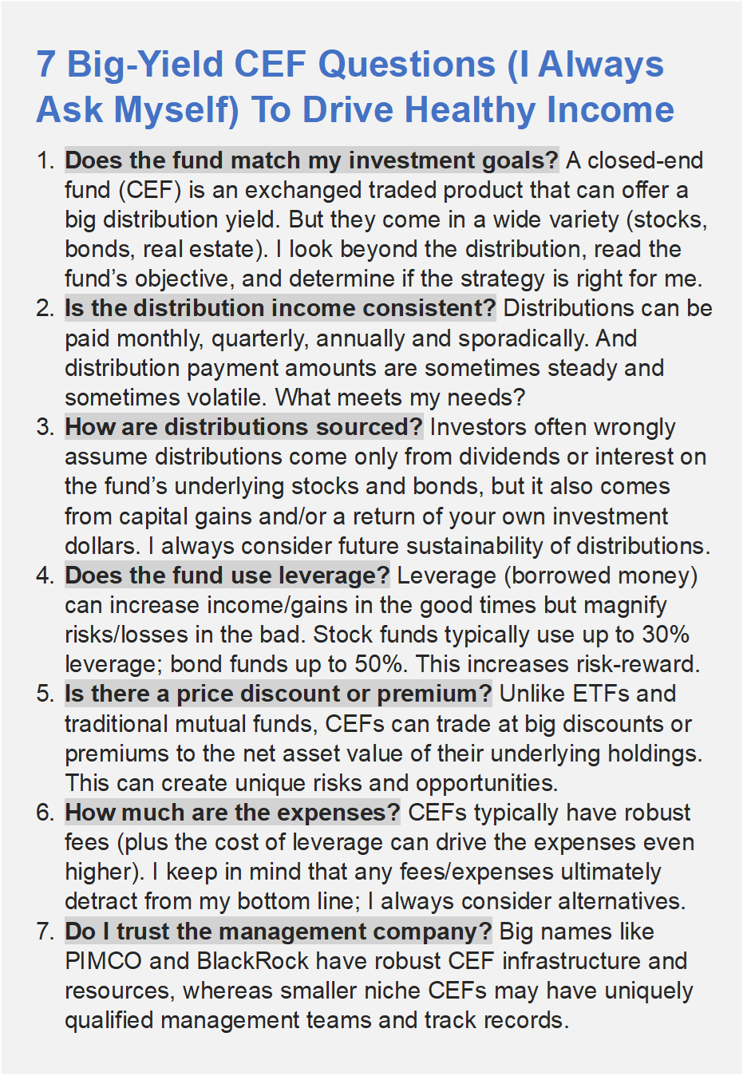
A bond closed-end fund (CEF) invests primarily in fixed-income securities like government, corporate, or municipal bonds and trades on an exchange like a stock. It typically uses leverage to enhance yield, which can increase income but also adds risks. CEFs can also trade at significant price premiums and discounts to their net asset value—which also creates risks and opportunties.
BDC: A business development company invests in small and mid-sized private companies, often through debt and equity financing. BDCs were created by an act of Congress in the 1980s to help small and mid-sized businesses, and they are also designed to provide income to investors through high dividend payouts.
Stock CEF: A stock closed-end fund holds a portfolio of publicly traded equities and trades on an exchange at a market price that can differ from its net asset value. These funds often use leverage and active management to generate higher income or returns than traditional equity ETFs.
Top Bond ETFs
SGOV holds short-term Treasuries for stability and liquidity.
VCRB provides core U.S. investment-grade bond exposure.
VTEB offers tax-exempt municipal income (after-tax efficiency) for taxable accounts owned by investors in high tax brackets.
VGHY targets higher-yield corporate credit for income.
VGMS diversifies across multiple credit sectors to enhance yield.
Risk Management
Closed-End Funds